
InesSense: the essence of Nature, as experienced through our senses – both the outer sensory pathways, as well as the inner senses. If you are wondering about your inner senses, try this: imagine apple pie. Can you see it in your mind’s eye? Can you smell it, maybe even taste it? Imagine a dog barking. Can you hear it? These are the inner senses.
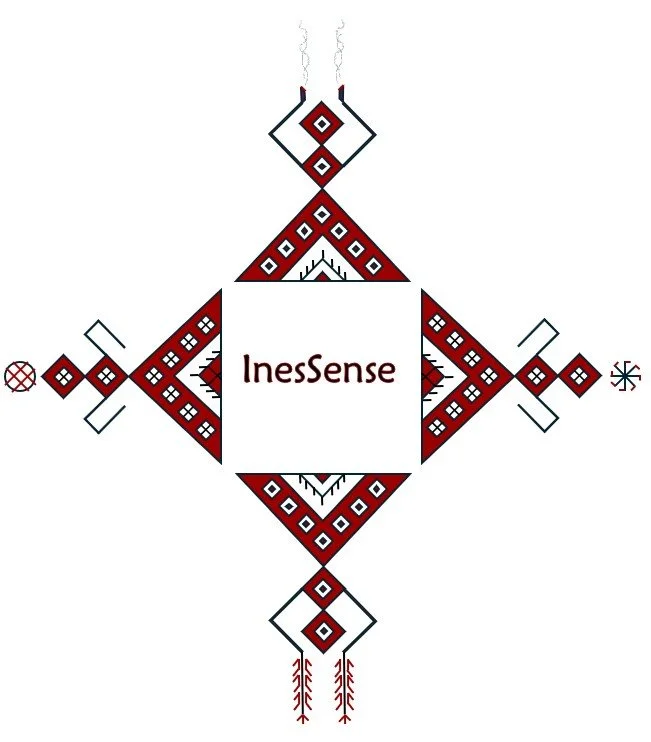
The InesSense logo is another expression of the essence of Nature... Meet Mokosh, a very old form of Mother Earth in Slavic folklore. She is often depicted in embroidery and other designs with arms raised upward or lowered depending on the season – I have chosen both forms for the logo. She governs spinning and weaving, water, earth, fertility, and women.
Mokosh’s legs are usually depicted wide and opened to the earth, in the birth position. Her skirt will contain emblems related to her gifts and teachings.
While it is not explicitly obvious, I have worked the solar cross (+) and earth cross (x) into the logo. The 4 representations of Mokosh are oriented in the form of the solar cross. The hems of the skirts align to give the illusion that “InesSense” is written on a label that is overlaid. The 4 corners of the central “label” suggest the earth cross through the centre.
With arms upraised, Mokosh is often depicted holding grains (illustrating fertility and sustenance… In Ukrainian, the word for rye is zhyto, and shares the same root as the word for life, zhyttya.) or holding roosters (associated with the sun, also life-giving) or other plants or birds. Her face, torso, and skirts represent a planted field (symbolized with a central “dot” filling in the open square). In my depiction, the upper Mokosh holds lit incense. The lower Mokosh holds grains, Life.
In old Ukrainian beliefs and practices, herbs were burnt for purification and protection (Obkuryuvannya Travamy – smoke from herbs for “fumigation”; Obkuryuvaty = verb, to fumigate using smoke). The making and burning of incense draws on all 4 elements of earth, water, fire and wind, and enjoins intention/ prayer as well. Herbs are grown, harvested and processed respectfully and prayerfully. Living water that has been collected from a minimum of 3 sources (as per old Ukrainian tradition: wells, wild water from lakes and rivers, rainwater) is added to the herbs to form the incense-dough. Water is key to alchemizing the herbs – to activate the “glue” that binds the mix together. Every stick is hand-shaped and dried with gentle heat and moving air (wind). It is lit mindfully, prayerfully, with thanks to the spirit of the elements, as well as the plants. Fire and wind allow the alchemized earth-materials to burn, cleanse, as well as carry your prayers to the Other realms.
The Mokosh representations whose arms are lowered toward the earth have depictions in their face, torso and skirt of open fields, ready for planting, or fallow for rest. Above one Mokosh is a moon, and reminds us that we are cyclical creatures, and planting seeds or harvesting food is often timed with varying phases of the moon. The opposite Mokosh has a sun above her head (8 arm star with “feet” that depicts movement and the nodes of the solar year as well as the teachings of the Tree of Life, with the combined solar cross (+) and earth cross (x)).
The central “triangle” on each skirt is a representation of mountains, and in particular the Mountain of Life that the Tree of Life sits atop, and of which the River of Life flows from and around.
Utilizing embroidery-style illustration and working with Mokosh as InesSense’s protectress implies working with textiles. Red, which is the colour of life and the common colour used to illustrate Mokosh, implies working with (natural) dye.
Altogether, these are the varying essences of Nature, and of the practices, teachings, and products I invite you to explore with me.